Project overview
Sociable Soccer 24/25 were PC and console arcade football titles and Sporty FC was the next iteration targeting mobile. There were roughly 20 consistent team members and my role was Designer and Animator. The games were developed in Unity.

Sociable Soccer 25/
Sporty FC
Challenges
One of the biggest challenges with this project was working directly under a Creative director who was very busy and was only available once a fortnight. This meant that the systems I was tasked to design had to be created almost entirely in isolation and still be in keeping with the vision.
The way I addressed this was to vaguely design any of the systems from a very top level point of view and then ensure that I got 30 minutes of his time when he was around to run him through my plan. I would ensure that I had a member of production there to note down any of the talking points and notes from him before getting him to sign off on the direction before he would leave again. I would then flesh out the system and address any feedback needed in the interim before I had the chance to present to him the progress the next time around. In this fashion I managed to develop a number of systems with some minor direction adjustments and iterations along the way.
The next challenge I ran into was ensuring that any of these systems would be able to run on a mobile device, specifically on mobile devices in tier 3 markets. Having worked on Sociable Soccer 25 which was a PC title, trying to recreate that level of depth and fidelity on these low end devices created a number of issues.
Modular Stadium
Overview
This was especially prevalent on the modular stadia system I was tasked with. The brief was to create a single stadium that would take data from our extensive CSV sheet and modify it to represent a number of stadia from all around the world. My approach to this was to split the design in two and tackle the stadium and immediate surroundings in one pass and the large environment and sky box in another.
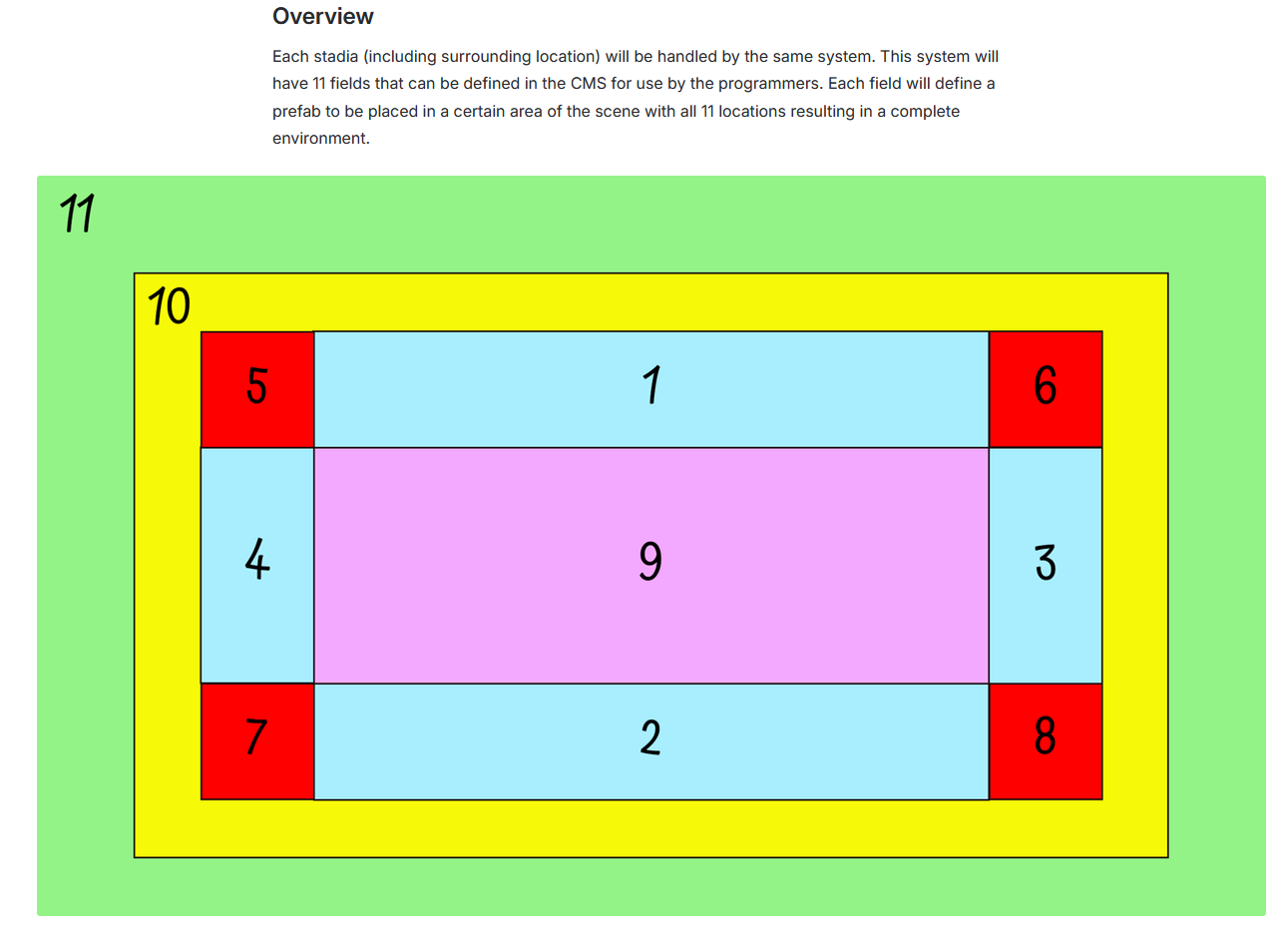
For the stadia themselves, I further broke them down into 10 components;
-
4 Individual Stands
-
4 Corner Sections
-
1 Pitch
-
1 Immediate Surrounding Area
(IMAGE OF Breakdown)
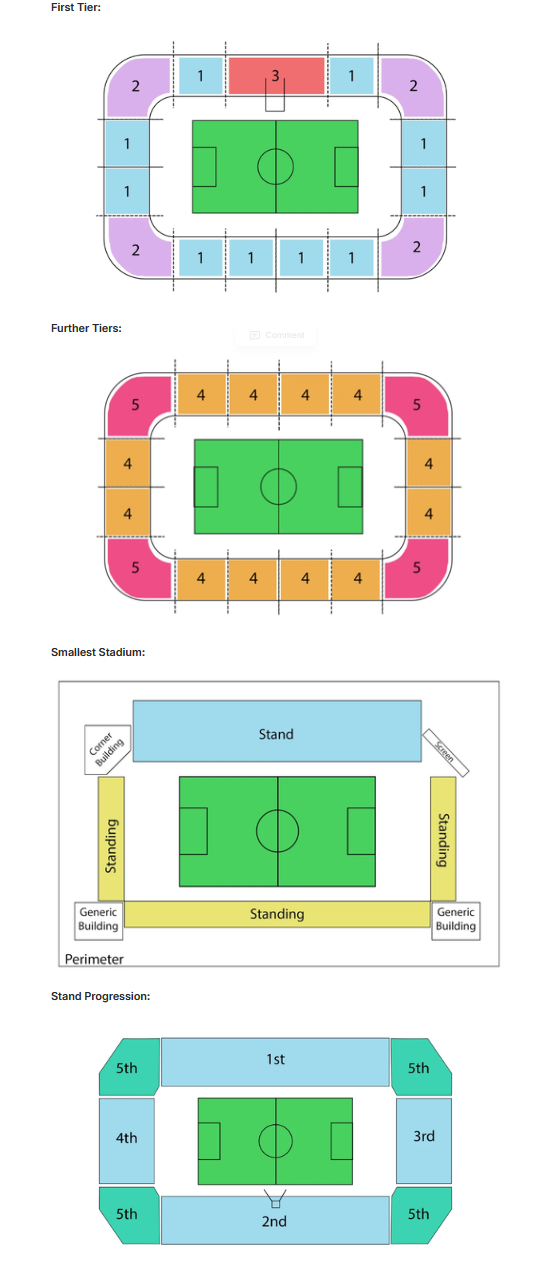
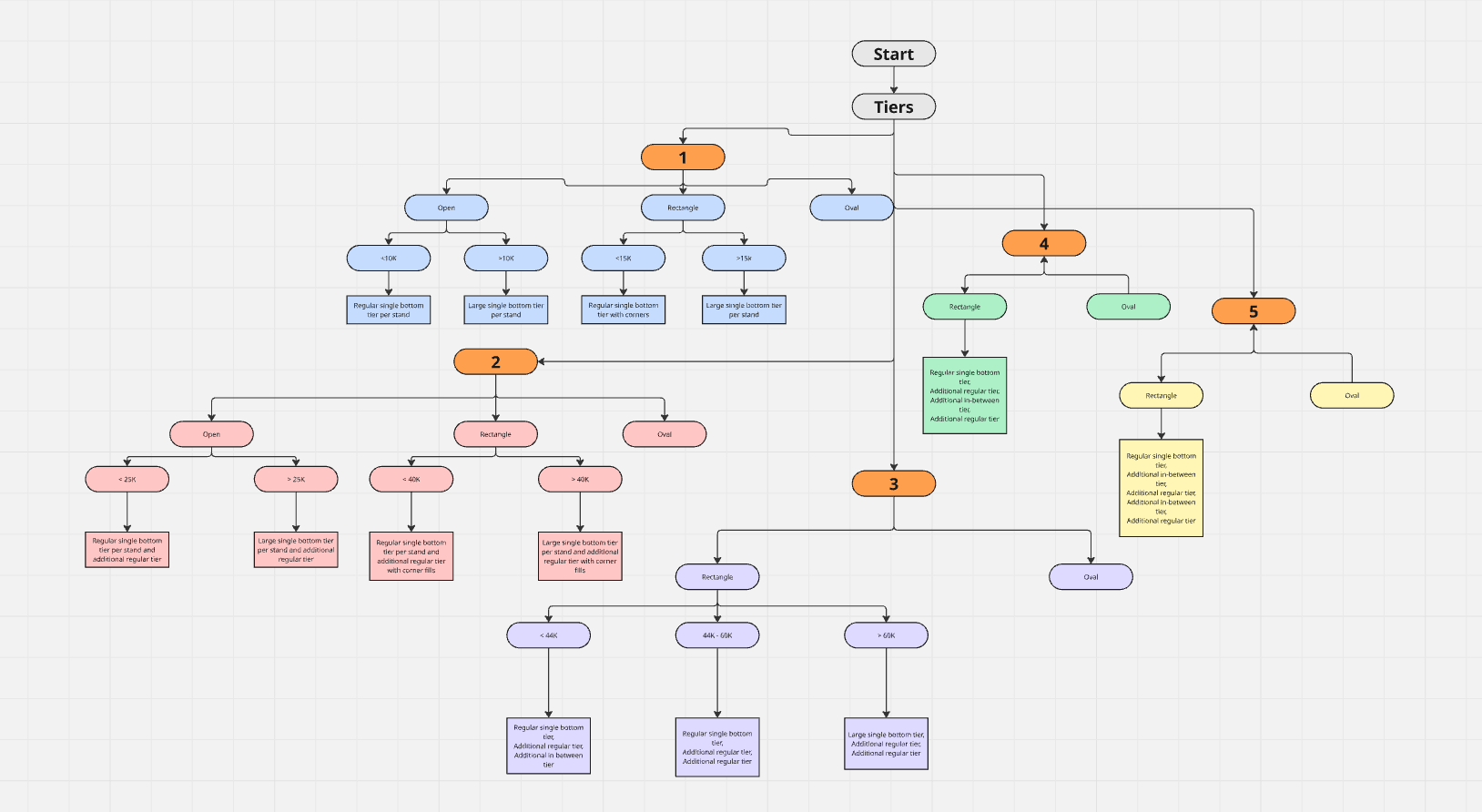
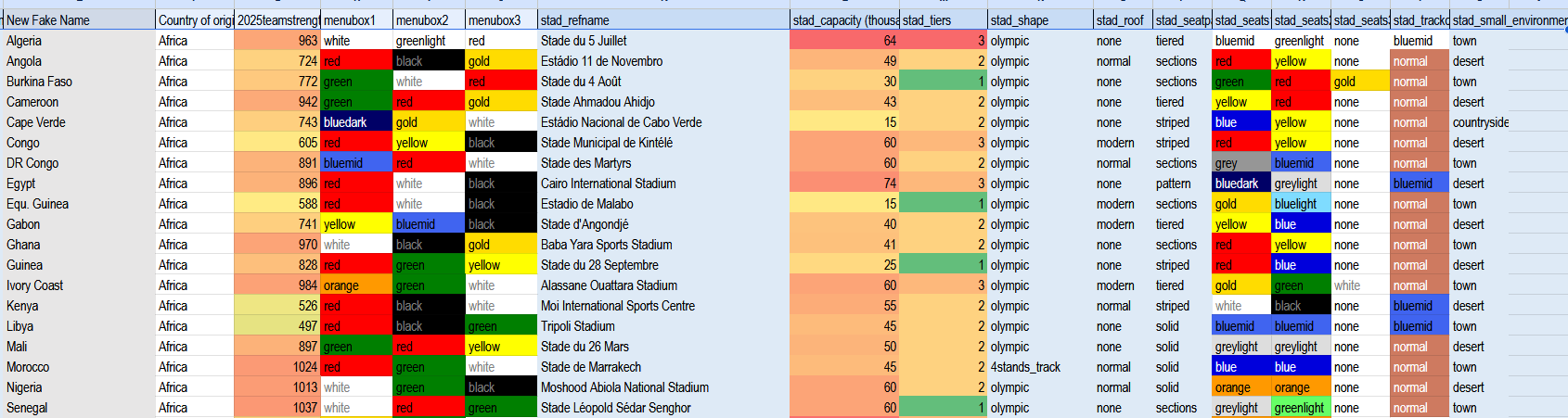
I then did some data analysis on the CSV and broke down the stadiums first by tiers of stands, then by shape, then by capacity. This was important to me because the tiers are only the first step (two tiers at Fratton Park are not equal to two at Workers' Stadium Beijing). The next steps of shape and capacity could arguably be done either way around but I elected to go for shape first. Once I had broken down all these data sets I looked at A LOT of different stadiums and what their tiers of stands looked like. There are a lot of different ways a stadium's stands can be broken down but I chose the two most common and created as many variations as I could for each group I had defined earlier.
(IMAGE OF How the Tiers Work)
What I was left with was a basic blueprint for lots of different stands, and a large number of groups of which to ascribe them to. A flowchart came next that could take in a single stadium from the CSV and output a stadium shape. The final thing to do was to find references of all these components as well as the set dressings that filled certain empty areas in the open stadia, and provide them to the artists.
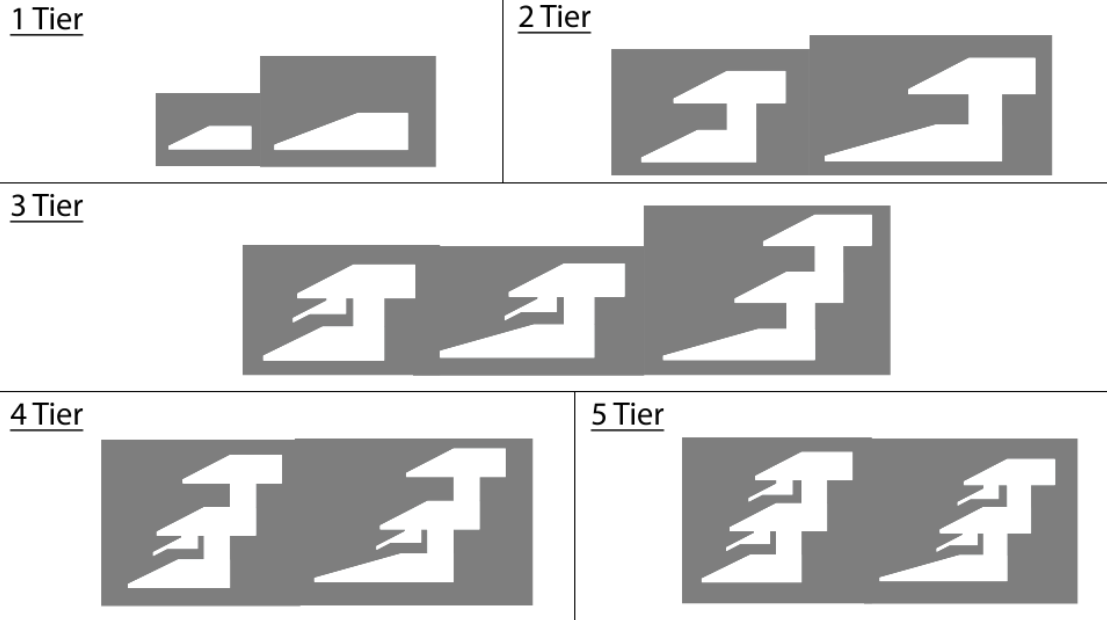
In the lens of optimisation, I broke down how a stadium could be built in some component parts as seen below. Breaking down the larger parts into sections like this meant that we could optimise one small part and then repeat it, batching them all together along the way. Adding to this that I requested one material be used for the whole stadium, we ended up with a simple looking stadium with minimal draw calls.
(IMAGE OF Cut up stands)




Environment
Similar to the stadiums I broke down the surrounding environment into sections. These went from highest fidelity up close out to simple billboards further away. The skyboxes became a collaboration with our tech artist to achieve some very basic vertex based clouds that were incredibly performant.
The groups for the environments were broken down into cities, rural and coast. And then each continent had their own version of each. The Cities were the easiest as, under strict mesh limits, the artist created a generic city and then added certain region specific set dressings and building toppers (billboards, water towers, etc.) This, coupled with slight colour palette change, led to some impressive variations at minimal cost. The rural areas were more of a challenge but working with the artist closely we managed to find enough overlap between the continents that we ended up with greater variation at a slightly larger cost.
Once all of these assets were made we created prefabs for everything, labelled everything and handed the documentation to the coder to implement. They found a slightly more streamlined approach of implementing it than I had envisioned, as is always the way, and the system was complete.

Stadium

I can take many positives from the project however. Many of my systems were green lit all the way up the chain of command and in another market they would have been seen by players.I also gained some valuable insights into collaborative development and got to work on a football game similar to the ones I grew up playing.
Unfortunately Sporty FC was cancelled before its full release. After a soft launch release in the Philippines it became clear that we had not done enough to make the game performant enough to provide an enjoyable experience on the low end devices used there. Having initially been aiming for a PC release and then pivoting to Mobile, the game was foundationally flawed for such a market and it was decided that it would take too long to rebuild everything from scratch.
Conclusions