Project overview
The Route Home is a solo game jam project developed by myself in two weeks for PC. The title follows a man on his way home from the pub who decides to take a shortcut back through some sunflower fields. In the preceding months, comets have fallen from the skies and wrought havoc on the local flora leading to a new norm. The protagonist finds out the hard way just how lethal that norm is. The game was made in Unity and I was responsible for Narrative, Design, Art, and Programming.

The Secret Song of Lake Billings
Research & Design
To start with, I began to research some of the things I wanted to include in the scenario. This was a crucial step to not only ground the players in reality, an important thing to do so that when the status quo is broken, it is all the more impactful, but also to draw inspiration from the peculiar nature our reality can sometimes show.
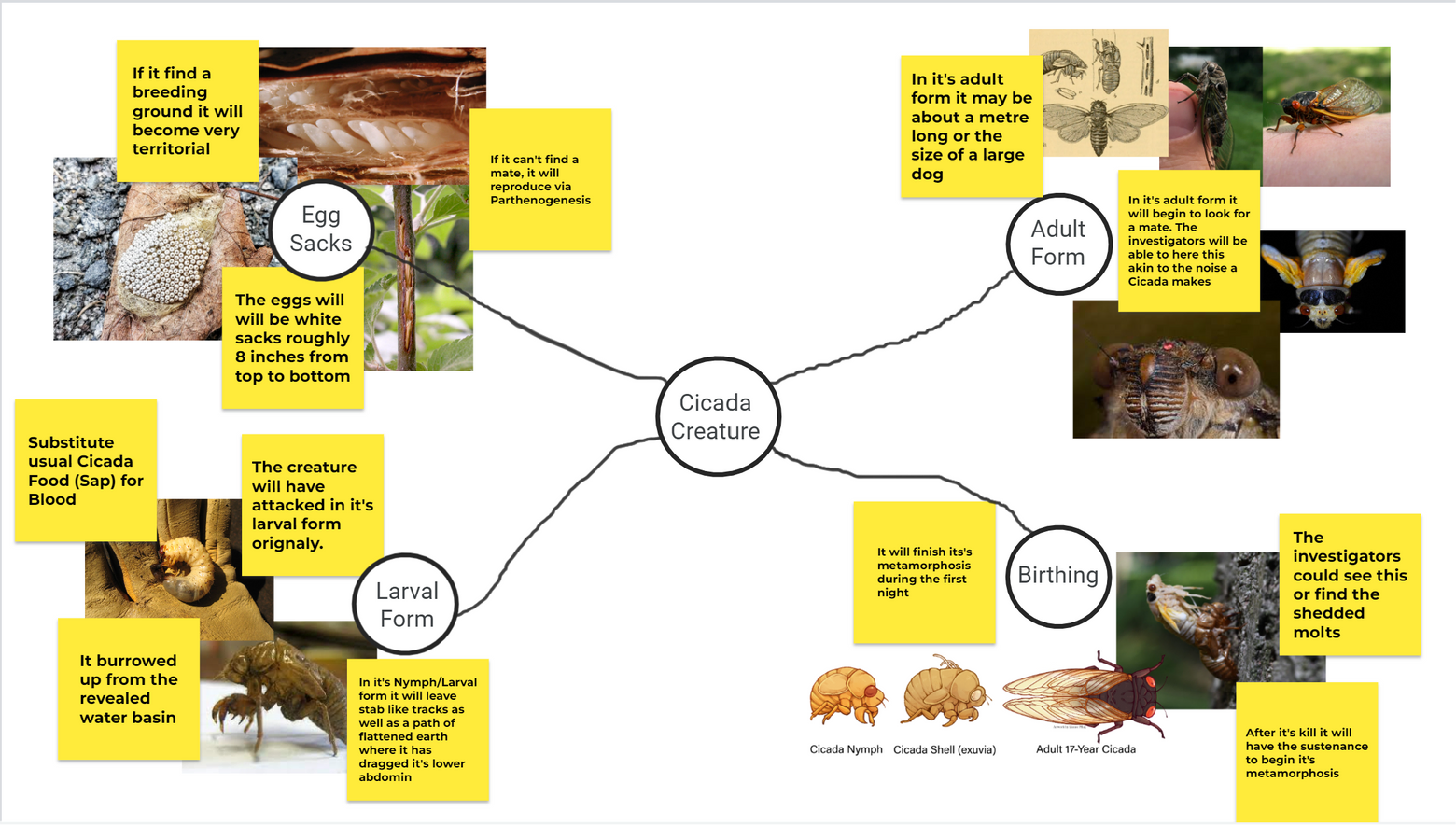
A perfect example of this is the Cicada, the main inspiration for the deadly creature plaguing the town of Kinsbridge and the “What?” of my mystery. The long dormant period of the strange insect was what initially drew me to it, but while looking into their lifecycle, I discovered just how much their bodies change shape. As I was already creating a fictional creature, I was able to hyper condense this growth from emergence as a larva to a fully mature specimen. This allowed me to do things like change the tracks left by the creature and change its primary animalistic objectives (My “How?”). The ability to have seemingly contradicting pieces of information about the same antagonist was incredibly appealing to me and I used this to try and instil uncertainty in the players right up until the time they discover the truth.
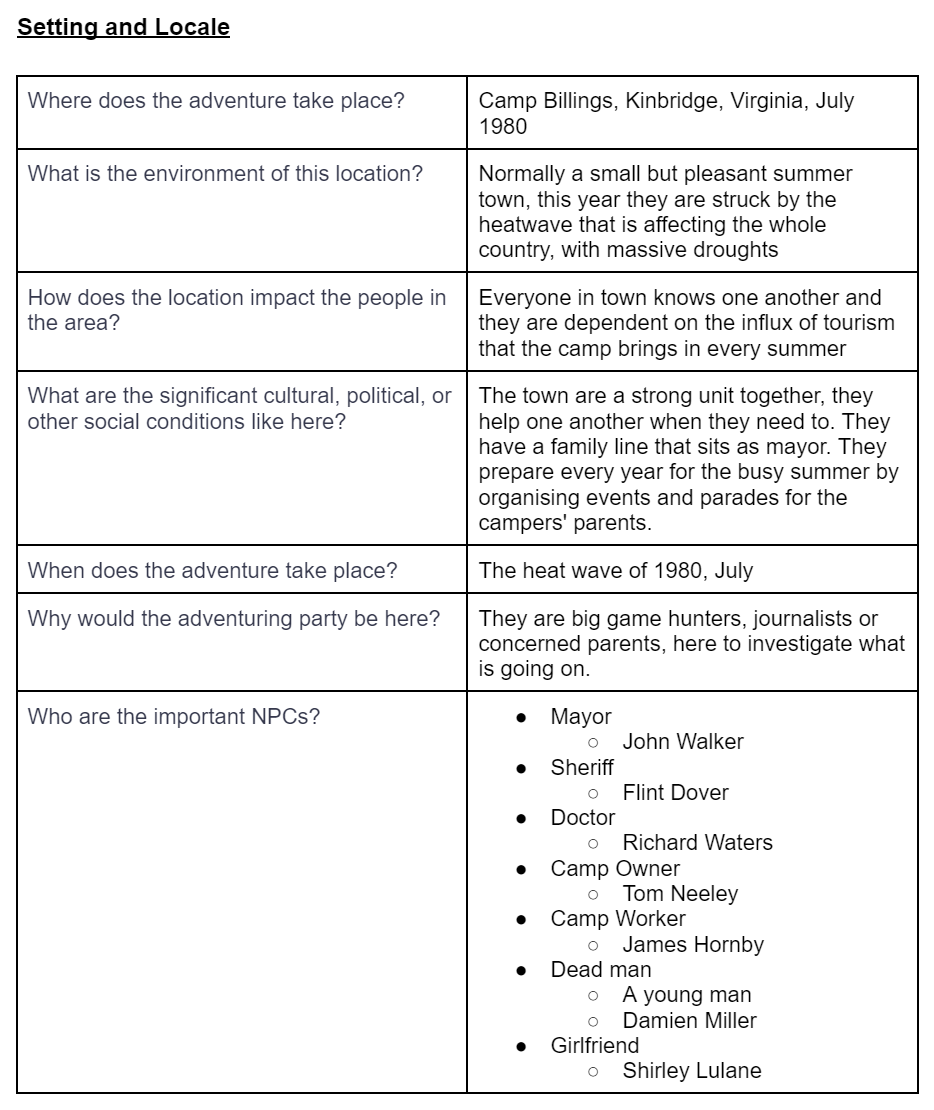
Once I knew the nature of my creature, and had already decided I wanted to set this in an 80s era summer camp, I had to figure out the catalyst for the “Why?”. I had it in my head that this creature would emerge from the lake, or at least the earth under it, that was the summer camp's namesake. I knew for that larva to emerge, the water level would have to recede, so I looked into extreme heat waves of 1980s America and I found that during 1980, the largest heat wave of recent history hit the middle states. I travelled east to where I knew there would be more wooded areas, and of course the east coast is where Lovecraft’s mythos thrives, and I landed in Virginia, my “Where?”.
There was more research involved but this is an example of my process that results in a horrific facsimile of a real insect set against a real place already going through a truly trying time.
With the nature of this being a one session scenario, certain design choices were made to keep the game length short. First of all, the mystery being investigated was kept reasonably shallow to give the players time to gather the clues and solve it, at least somewhat, and still have time for the final encounter with the creature. The problem I encountered here was keeping the investigation engaging and not too easy. Fortunately for me, the nature of the creature I created, and the “unknowable horrors” theme of the game, gave me a lot of room to drip feed information that didn’t form a whole picture and the clues themselves would only give them a picture of what had already happened, both with the killing and 30 years prior. This kept the player learning but didn’t push them into the active “hunt” phase of the game and gives the keeper a chance to build up the atmosphere by introducing locations around the town/lake and also the NPCs that fill those spaces.
I next designed a way to give the keeper a time management tool that can be used to create a satisfying conclusion for even the slowest of parties. This was done by utilising a timeline of events that takes into account a day/night cycle as well as the heavily accelerated life cycle. The way it works is by giving the players the first day after the inciting event to explore and investigate before the creature attacks the following night. During this day the creature is hidden out of sight in a cocoon, transforming into its adult form. In the morning of the second day, the mayor, who hired the players, summons them back to the lake to seek out a missing NPC who they will have met the previous day. He will be found dead near his home along with a much clearer trail to the creature and the final encounter. Diligent players will of course be able to find the creature without keeper intervention and it’s highly likely that they will find information along the way that will greatly increase their chances of survival.


Handouts, Layout & Editing
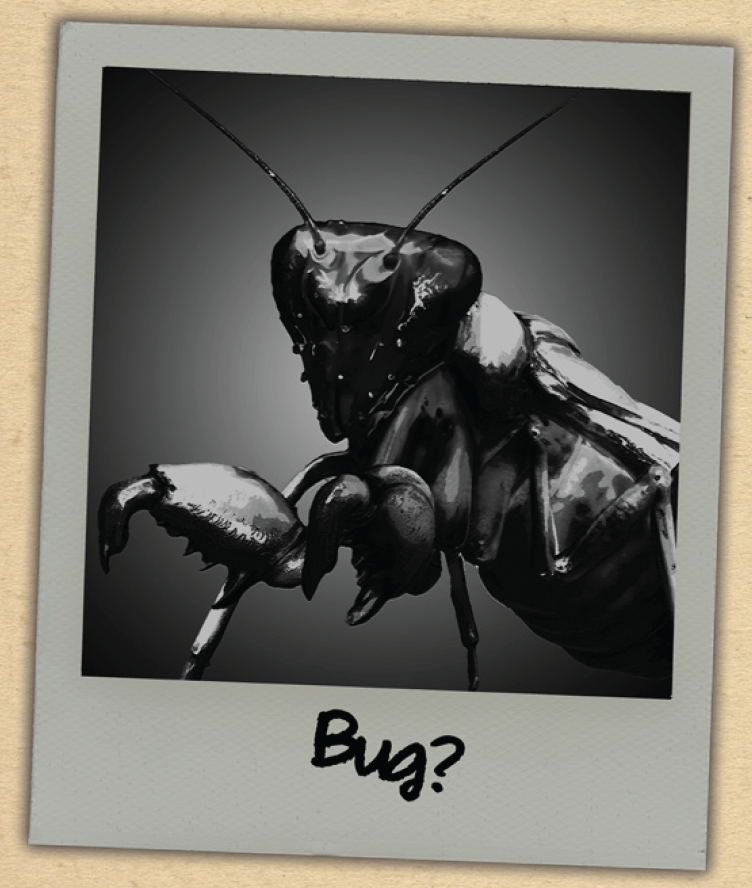
For the two art assets (Cover and Creature), I used a collection free to use images, cut up and photo bashed together with photoshop with some additional editing to make them cohesive images. For the creature, I then framed it in a polaroid photo with a vignette to give it more of an in-world feel in keeping with the time period.
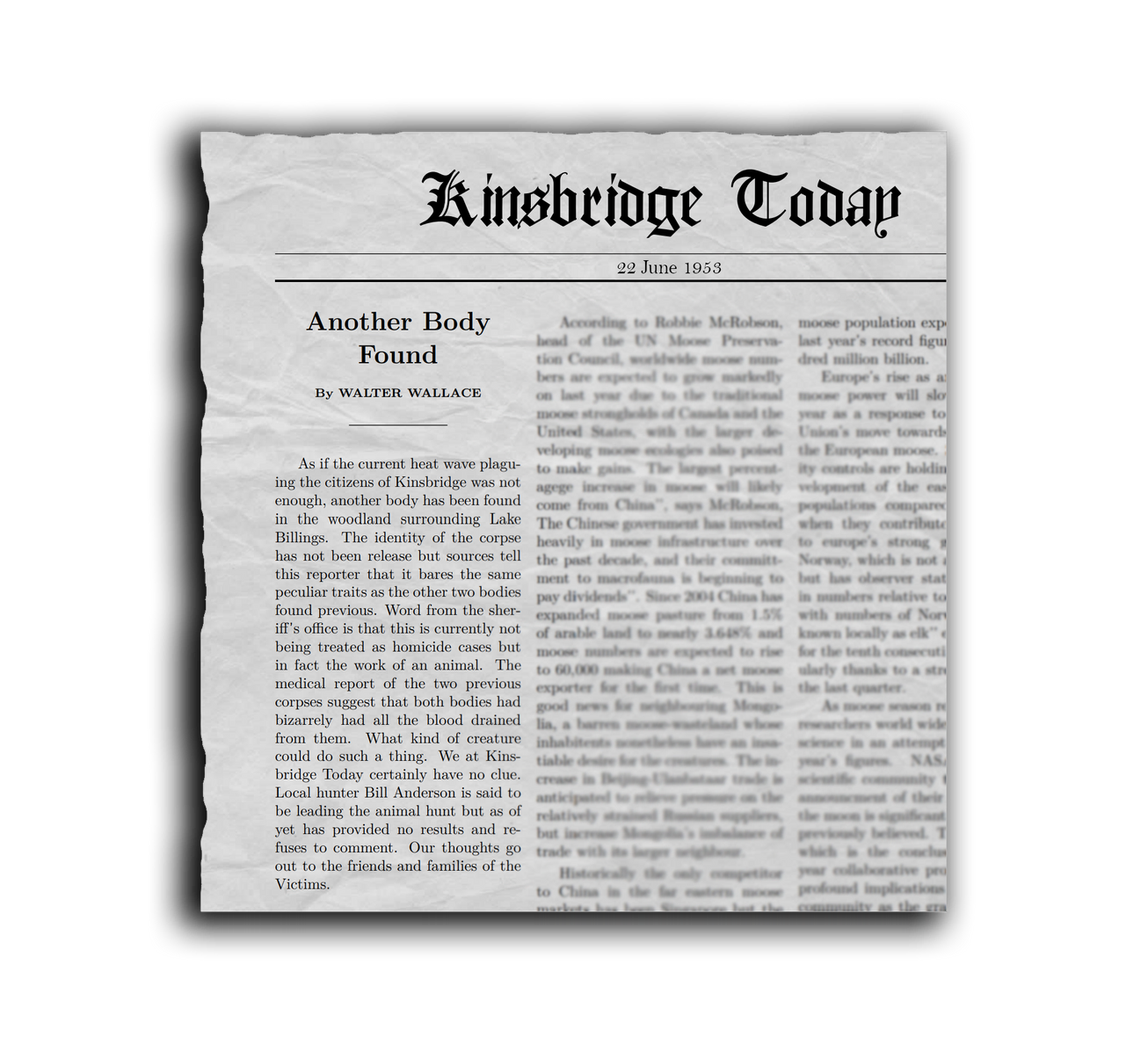
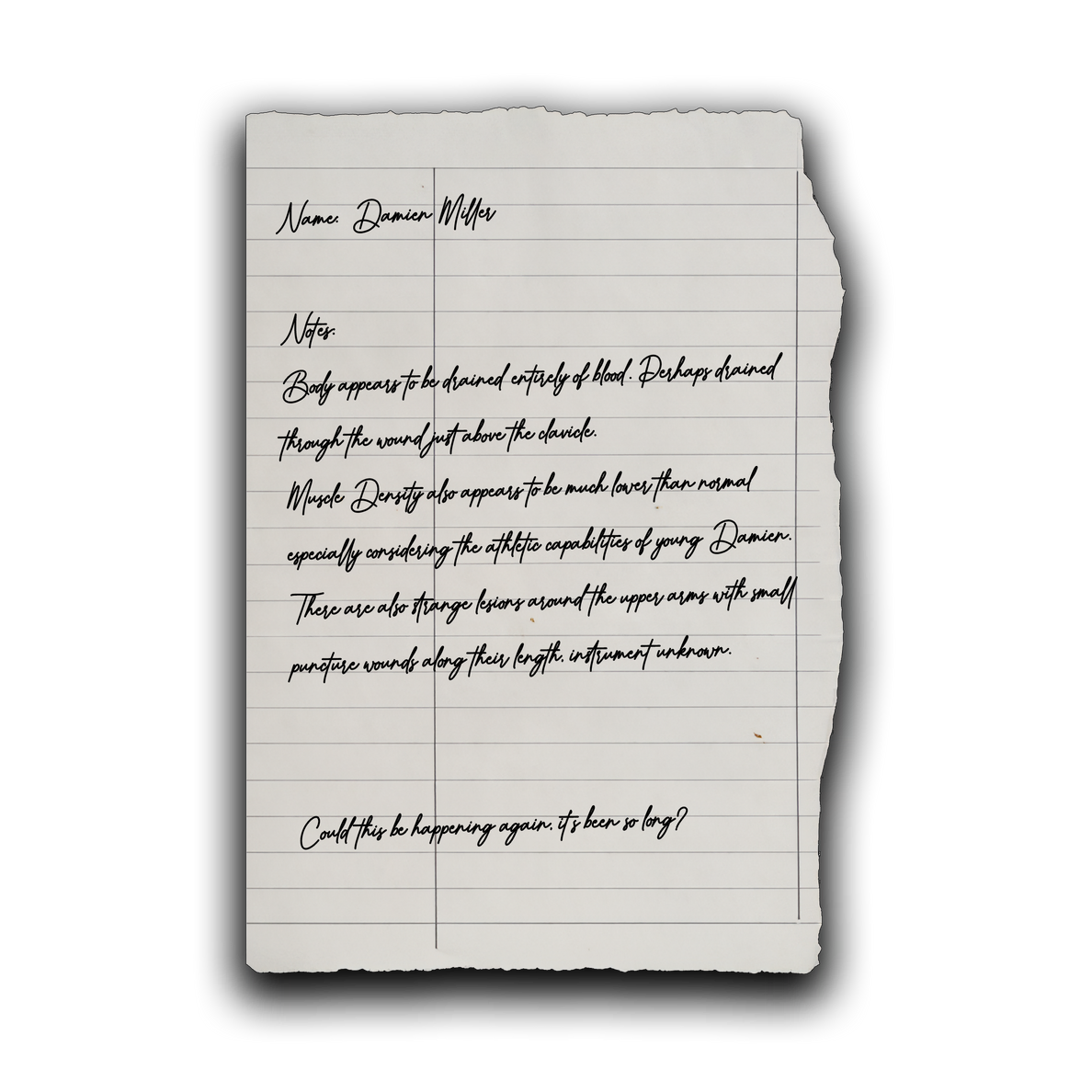
Two handouts were created being; a newspaper clipping from 30 years ago in game, and a handwritten doctor’s note regarding the state of the corpse. Both of these point in the direction of, or allude to, the NPC “Old Bill”. The newspaper cupping was made in an online generator and then edited in Photoshop. The doctor’s note was entirely created in photoshop and an easy read version was also created for accessibility purposes.
The final step in asset creation was to make the elements that would be used in the final document. This consisted of page backgrounds, pop out boxes for additional keeper tips, and sourcing of fonts. This was all done to fall in line with Chaosim’s pre-existing format.
The playtesting consisted of three run throughs of the game. The first being run by myself with a known group of players to establish the coherence of the mystery. The second being a game run by someone else given no information other than what was in the document to simulate an end user situation. Finally, I ran the game two further times in convention settings to evaluate the length of the game with unknown players. The final two stages of playtesting highlighted some areas that could be improved but mostly these amounted to rewording of certain sections and reconfiguring the order of the document to better accommodate the flow of play.
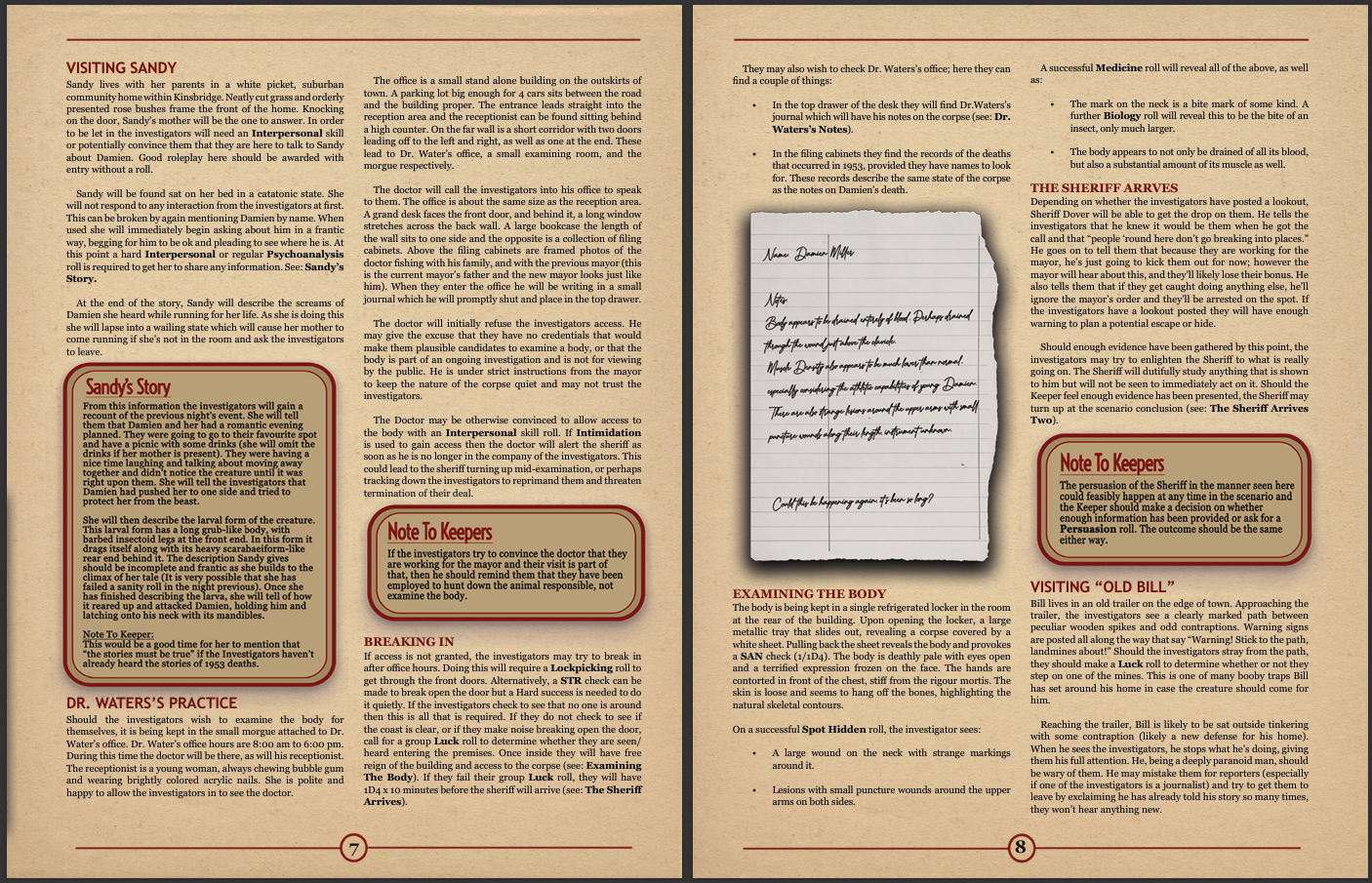
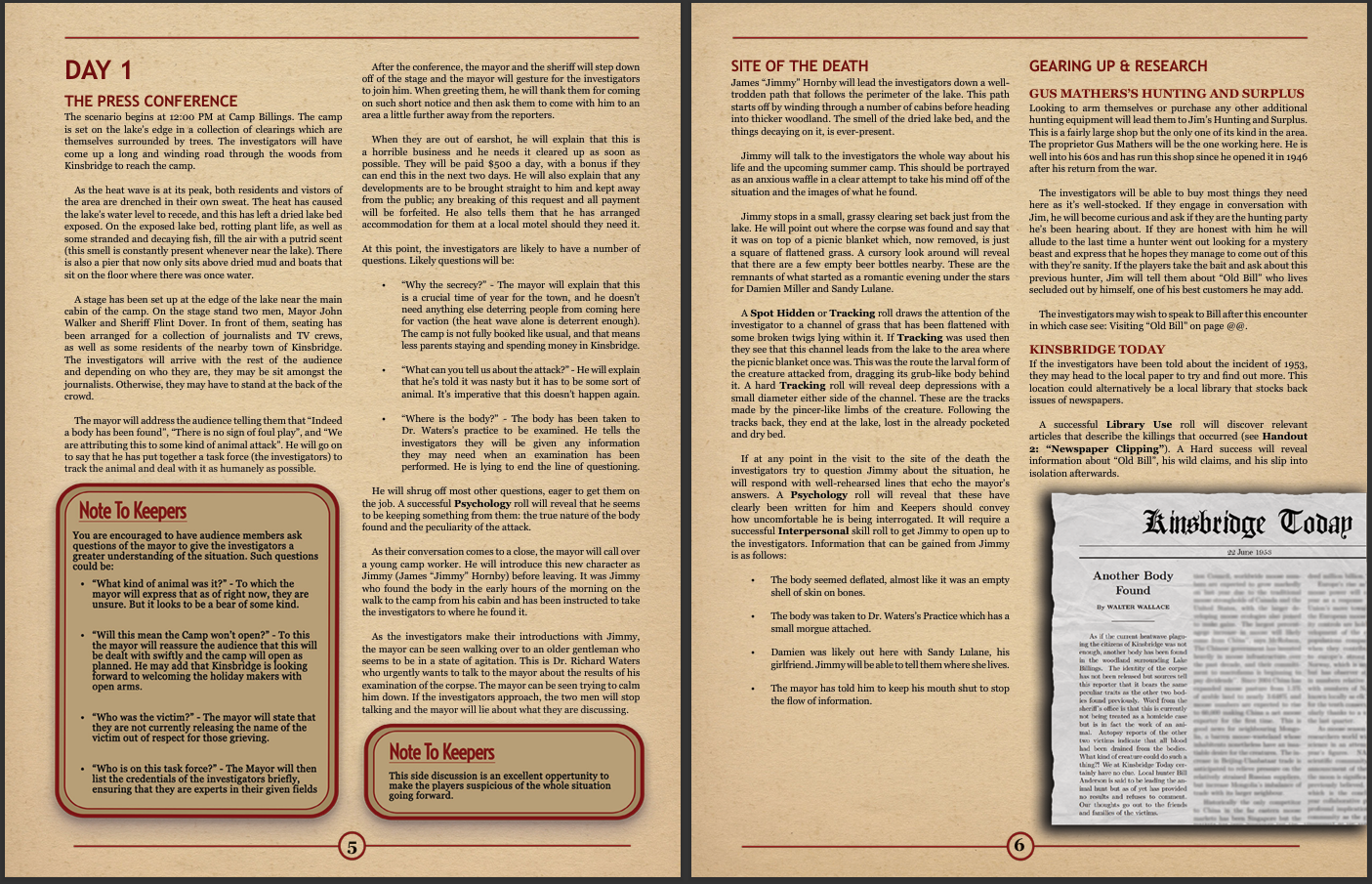
Once Playtesting was done the layout was completed using InDesign. Chaosim provides a useful template that only needed a few tweaks to fit my purposes. This was my first time using InDesign but I found the process to be enjoyable and managed to develop a flow of information that would be useful to anyone running the game. Once this was done, it was sent off to an editor for final tweaks and adjustments before being published to the Miskatonic Repository via DriveThruRPG.






The Secret Song of Lake Billings has sold roughly 50 copies to date and can be found here:
www.drivethrurpg.com/product/461538/The-Secret-Song-of-Lake-Billings?term=the+secret+song+of+lake
One thing this project did teach me however is that consistency results in greater results as I had a brief lull in production in the middle of the project and coming back to it was almost as much of a challenge as the project itself.
This was an incredibly enjoyable project to work on and marks my first formal entry into the world of tabletop publishing. I learnt some important lessons along the way, the standouts being; the importance of editing (and having an editor), and how much pre-production and research can streamline the actual writing. Playtesting yielded some good results and I had the added bonus of seeing a particular scene elicit strong emotions from one group of players while electing tremendous humour from another, further cementing my love for the storytelling capabilities of the medium.
Conclusions